Award winning Taupō author Donovan Bixley is not one to let the assimilation of some good material go uncapitalised.
“Over the last few years, I've done all these books like Māori Myths and Legends and books about native New Zealand flora and fauna, nonfiction books… finding out all this stuff and interpreting it for kids and I thought it would be fun to take all the information I've learnt and turn it into a fun fictionalised book.”
Books as fun has always been Bixley’s mantra – not that there isn’t a little learning happening at the same time.
The format of his new book, ’Feathered Friends’, out yesterday (Thursday, November 12) is an important aspect.
“It's trying to combine my love of picture books with chapter books, and I've done a lot of books in that space before, but this is even more trying to make a full colour picture book that's a chapter book.
“So fewer words, more pictures, full colour. This is the transition from picture books to chapter books.”
He imagines ‘Feathered Friends’, the first in what might be a series of four or so Pīwakawaka People titles, will appeal to five- to seven-year-olds.
“Right in the picture book zone, but a short read over a few nights.”
He says he’s taken some inspiration from being involved with “really cool groups” like Kids Greening Taupō.
“Their art competition and their big greening day and talking to people and seeing the things that I'm passionate about. There's a whole bunch of people out there who are really passionate about them too.”
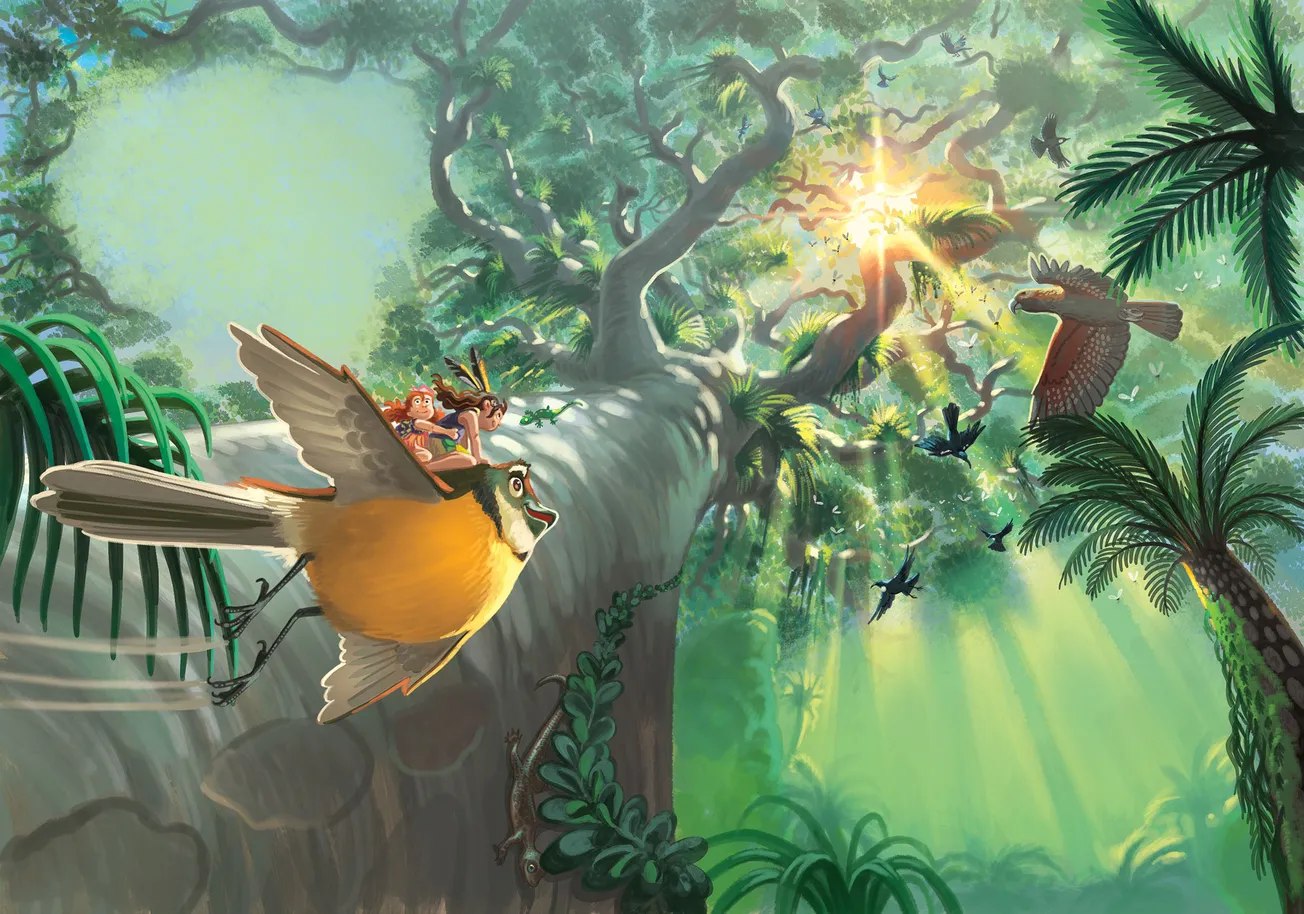
The story involves a fantasy version of New Zealand with kids who fly around on the back of the Pīwakawaka (fantail).
“They're an immigrant, tiny family who have come to the pristine forest of New Zealand, but there are various dangers so they have to protect the forest.
“I guess it's a kind of metaphor. Kids feel tiny and small, and big people have all the power, so this is taking that idea to the absolute extreme, making the characters tiny people who can still have an impact in the world and protect the environment and do good things, which is a nice message to send to kids… You can still make a difference.”
While Bixley says a large part of his focus for the last 25 years, has been on trying to do big international books, he has come back to: “Ah, who cares about the rest of the world?
I'm going to do something that's a really localised New Zealand story. An essentially kiwi thing.”
And who knows it might still sell well overseas.
“That's something the publisher and I were talking about… maybe you have a better chance by doing something uniquely New Zealand that’s a universal story about protecting the environment.
“But it's all wrapped up in a fun adventure. All very light-hearted but with a solid message.”
As well as youth conservation action, inspiration for the Pīwakawaka content harks back to the arrival of a few of his own forebears in New Zealand.
“On dad's mum's side, there were a couple of Irish kids, aged nine and 11, who got sent out to New Zealand…they were just sent by themselves by their family from Northern Ireland in 1822 sent out to Whangaroa, never to return.
“So that was a bit of an inspiration. I can tell a story about New Zealand from that point of view – an immigrant family who comes here and goes, wow, cool, and embraces the culture, learns how to speak Māori, wants to get involved.”
Without spoiling the series, threats come in the form of invasive species and deforestation.
“So being able to address those kind of issues. And your publishers say, ‘Isn't that a bit scary for kids?’ but then you go around to schools, and they’ve got dead stoats and taxidermied stoats and stoat traps and rat traps. Certainly, in the Taupō region kids are right into murdering invasive species.”
His cool facts from doing non-fiction books keep bubbling up.
“Kahikatea trees grow in swamps, so when Europeans turned up, they went ‘Woohoo’ that's why they built Thames, where they built Thames, because Cook thought this is going to be the new London. There were a trillion kahikatea trees there and they thought these will make awesome masts, they grow in swamps, they must be waterproof, but Māori knew you don't make anything out of kahikatea, because as soon as you chop it down, it rots.
“I thought these things are quite funny but kind of scary. Chopped down an entire forest and then discover that it was a waste of time.”
Kids and parents can catch Bixley at a free public event to mark the book launch:
Taupō Library on Saturday, November 14, 10.30am.